For most of the past decade, streaming infrastructure was somebody else’s problem. Content delivery networks absorbed the complexity, and media engineers focused on codecs, bitrate ladders, and player performance. That arrangement is quietly falling apart. By 2026, the weight of live and on-demand delivery has grown heavy enough that a new breed of engineer is being asked to own the architecture beneath it — not just the application sitting on top.
This isn’t a minor role expansion. It’s a fundamental redefinition of what a media engineer is expected to know and build.
The CDN Model Is Showing Its Age
Traditional content delivery networks were designed for a world of scheduled broadcasts and pre-buffered VOD. They excel at pushing static assets from edge nodes close to end users, and for years that was enough. But the streaming landscape has changed in ways that strain the model at its seams.
Concurrent viewership for major live events now routinely exceeds eight figures. Interactive formats — live commerce, co-watching, real-time polling — demand sub-second delivery rather than the three-to-eight-second latency that ABR streams have historically accepted. And emerging markets, where last-mile infrastructure is inconsistent, are pushing platforms to look beyond centralized origin servers for answers.
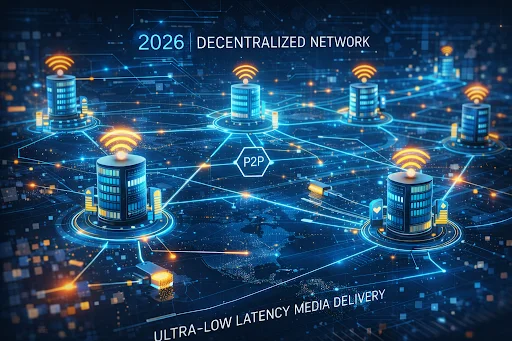
The industry’s response has been to accelerate a shift toward Virtual Network (Vnet) architectures and peer-to-peer delivery — solutions that distribute the burden of transmission across the viewer population itself, reducing origin egress costs while dramatically cutting latency at scale.
What Decentralized Streaming Actually Looks Like
Vnet, in the media context, refers to overlay networks that treat viewer devices as participating nodes. Segments that one viewer has already downloaded become available to nearby peers, reducing the distance data needs to travel and offloading traffic from central servers. It’s conceptually similar to BitTorrent, but engineered for live streams where segment availability windows are measured in seconds.
The engineering challenges here are substantial. Peer discovery must be fast enough not to stall playback. Segment verification must prevent corrupted or tampered data from entering the swarm. Fallback to CDN origin must be seamless when peer availability collapses — say, at the end of a live event when viewers drop off simultaneously. And the entire system must degrade gracefully on mobile networks where upload capacity is constrained.
Several major platforms including Akamai, Limelight (now Edgio), and startups like Streamroot (acquired by Broadpeak) and Phenixp2p have deployed or productized P2P delivery layers. Industry benchmarks from Broadpeak’s WebRTC-based technology have demonstrated CDN offload rates above 40% during high-concurrency live events — a meaningful reduction in per-gigabyte delivery costs at scale.
The Certification Gap Threatening Hiring Pipelines
The skills required to build and operate these systems are not yet common in traditional media engineering pipelines. Video engineering backgrounds favor codec knowledge and quality metrics. Software engineering backgrounds may lack the networking depth to reason about transport protocols, congestion control, and network topology. Both disciplines need to expand — and employers are increasingly requiring proof of competency.
Cloud architecture certifications — particularly AWS Certified Solutions Architect, Google Professional Cloud Architect, and Microsoft Azure Solutions Architect — have become baseline requirements for roles touching live streaming infrastructure at scale. Networking certifications like Cisco’s CCNP or CompTIA Network+ are being added to job descriptions that would have previously required only application-layer knowledge.
More specialized credentials are emerging too. The Society of Cable Telecommunications Engineers (SCTE) has expanded its certification catalog to cover IP-based video transport. AWS offers a Media Services specialty track. And protocol-specific knowledge — QUIC, WebRTC, SRT — is increasingly assessed through both vendor certification programs and open-source community credentialing.
Proving the Knowledge: Why Exam Preparation Has Become a Professional Discipline
Understanding P2P delivery theory is only half the fight in 2026. The real challenge isn’t just having the knowledge, it’s proving it with industry-standard certifications. Certification exam prep has become a crucial part of the career path for media engineers due to the increasingly demanding standards. Aspiring developers can bridge the gap between theory and practice by simulating real-world network scenarios. Mastering these logic-based problems ensures a first-time exam pass and a faster transition into the workforce.
The exams themselves have evolved to reflect operational complexity. Questions on AWS media services certifications now probe multi-region failover logic, CloudFront behavior under high-concurrency load, and cost optimization across egress tiers. Networking certifications test candidate understanding of transport protocol selection — when to choose QUIC over TCP for ingest, or how to configure SRT for contribution feeds over public internet paths with variable jitter.
Engineers who have passed through structured practice regimens consistently report better performance on scenario-based questions compared to those who studied from documentation alone. The gap makes sense: documentation describes how systems work; practice exams force you to make decisions under constraint, which is closer to how engineering judgment actually gets applied in production environments.
Building the Right Skill Stack
For engineers targeting roles in next-generation streaming infrastructure, the learning path divides into three layers. Transport and protocol fundamentals form the base: QUIC, WebRTC, RTP, SRT, and the tradeoffs between UDP-native and TCP-emulated approaches to low-latency media. Cloud architecture knowledge sits above that: how to design elastic transcoding pipelines, configure origin shield topologies, and instrument observability for distributed delivery systems. And P2P-specific knowledge occupies the top: NAT traversal techniques, peer scoring algorithms, swarm health metrics, and the regulatory considerations around using viewer devices as relay nodes.
No single certification covers all three layers, which means the engineers advancing fastest in this space are assembling composite credentials — combining cloud provider certifications with networking credentials and self-directed study of open standards like DASH-IF and CMAF. The role of the media engineer in 2026 is, in that sense, genuinely new: a hybrid of disciplines that only recently existed in separate professional silos.
The Architecture Era Has Already Started
The shift to decentralized streaming isn’t a future prediction — it’s already underway at the major platforms, and it’s pulling engineering job requirements along with it. Engineers who understand only the application layer are finding their scope narrowing. Those who can reason about transport protocols, cloud architecture, and P2P overlay design are finding their scope expanding rapidly.
The certifications that validate this knowledge are becoming the new baseline, not a differentiator. Getting ahead of that curve — through deliberate study, structured practice, and targeted credentialing — remains one of the most direct paths into the roles that will define how media is delivered over the next decade.
For more info click here